In food, beverage, and pharmaceutical processing plants, keeping machinery running smoothly while maintaining absolute product safety is a daily balancing act. Processing equipment—from high-speed conveyor belts and mixers to bottling lines and ovens—requires lubrication to prevent friction, wear, and mechanical failure.
However, using standard industrial lubricants near food production creates a serious contamination risk. That is where food-grade lubricants come in.
What Are Food-Grade Lubricants?
Food-grade lubricants are specially formulated oils, greases, and synthetic fluids designed for use in equipment where contact with food, beverages, or pharmaceuticals could potentially occur.
Unlike standard industrial lubricants, food-grade formulations are made from high-purity, non-toxic base stocks and additives approved by regulatory bodies like the U.S. Food and Drug Administration (FDA). They are engineered to be odorless, tasteless, and completely safe in minute, accidental amounts, without sacrificing the heavy-duty protection machinery needs to run reliably.
The Three NSF Classifications Explained
To ensure safety across different plant zones, lubricants are registered under specific NSF International classifications based on their risk of food contact:
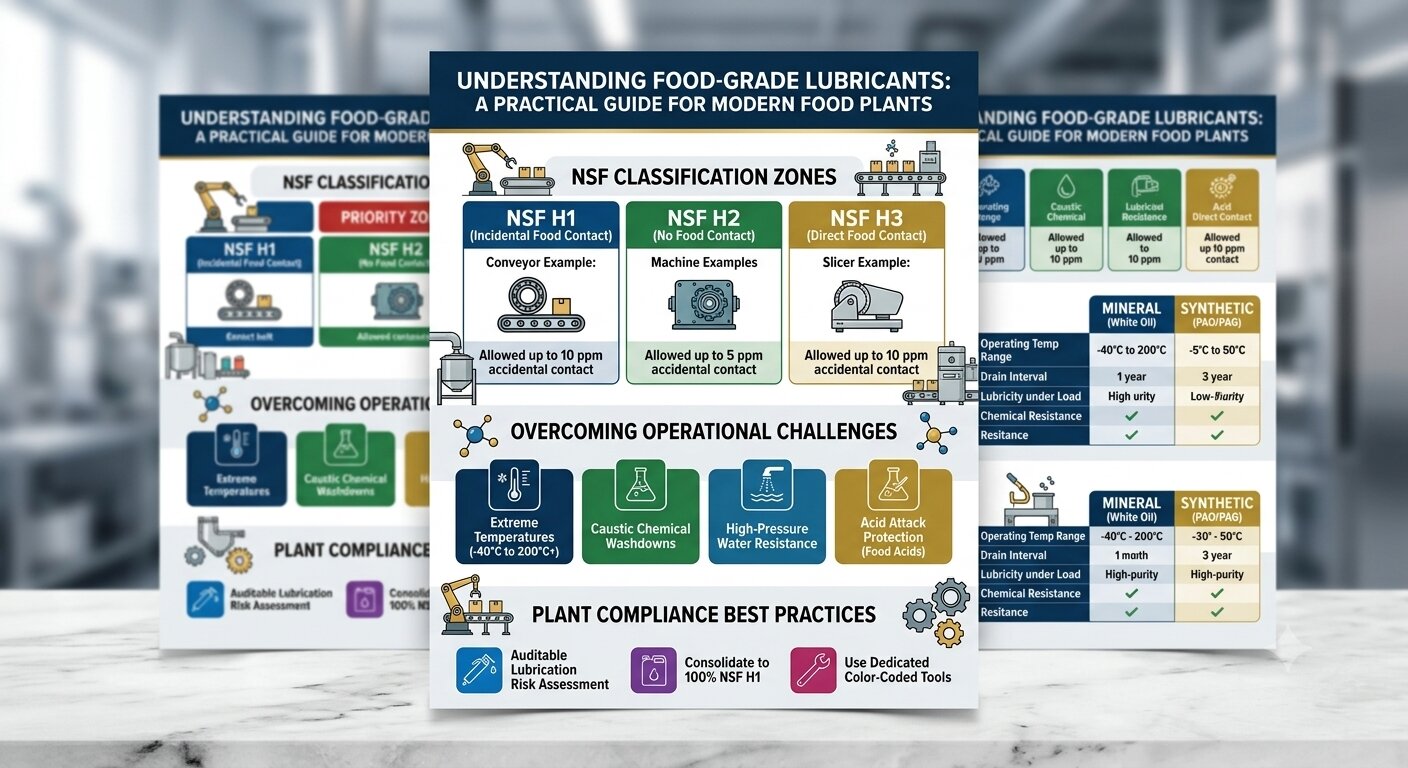
NSF CLASSIFICATION ZONES
┌──────────────────────┼─────────────────────┐
NSF H1 NSF H2 NSF H3
Incidental Food Zero Contact Direct Contact
Contact Potential Potential Allowed (Soluble Oils/Edible coatings)
-
NSF H1 (Incidental Contact): Used on machinery where there is a technical possibility of the lubricant coming into accidental contact with food (e.g., overhead conveyors, mixer bearings, pump seals). Incidental contact is legally capped at 10 parts per million (10 ppm) in the final food product.
-
NSF H2 (No Contact): Industrial-grade lubricants used in fully enclosed equipment or utility areas where there is zero chance of touching food lines or packaging (e.g., boiler rooms, closed drive systems).
-
NSF H3 (Direct Contact): Soluble oils or edible coatings used directly on equipment like meat hooks, slicer blades, and trolleys to prevent rust and ease cleaning before processing.
Key Operational Challenges Food-Grade Lubricants Face
Food processing environments present severe mechanical and environmental stresses that lubricants must overcome:
-
High-Pressure Washdowns: Plants frequently sanitize equipment using high-pressure hot water and caustic chemical detergents. Food-grade greases must offer superior water-washout resistance so they don't wash out of bearings.
-
Extreme Temperatures: Lubricants must remain fluid in spiral freezers operating at -40°C (-40°F) while resisting breakdown in baking ovens operating above 200°C (392°F).
-
Chemical & Acid Attack: Exposure to organic food acids (citric, lactic, malic acids) and cleaning agents can cause standard oils to break down quickly. Food-grade synthetic formulations protect metal components from corrosion.
Mineral vs. Synthetic Options
Choosing the right base stock depends on your operating environment and budget:
|
Feature |
Mineral (White Oils) |
Synthetic (PAO / PAG) |
|
Initial Cost |
Economical |
Higher initial investment |
|
Operating Temp Range |
Moderate |
Extreme low to extreme high |
|
Drain Intervals |
Standard |
Extended (2x to 4x longer) |
|
Best Used For |
Light to medium duty, standard hydraulics |
Heavy loads, ovens, freezers, severe washdowns |
Best Practices for Plant Compliance
-
Conduct a Lubrication Risk Audit: Identify all Critical Control Points (CCPs) where lubricants could potentially touch food lines.
-
Consolidate to 100% NSF H1: Many plants switch their entire production floor to NSF H1 products. This eliminates the risk of a technician accidentally applying a non-food-grade lubricant to a sensitive bearing.
-
Use Dedicated, Color-Coded Tools: Assign specific grease guns, oil transfer cans, and fill ports (e.g., purple or blue) exclusively for food-grade products to prevent cross-contamination.
By selecting the correct NSF-certified lubricants and following structured maintenance practices, food processing facilities can protect their equipment investment, maximize uptime, and ensure complete peace of mind during safety audits.